Esta página aún no está disponible en español. Se muestra en English.
Presentation By Dr. Amael Borzée
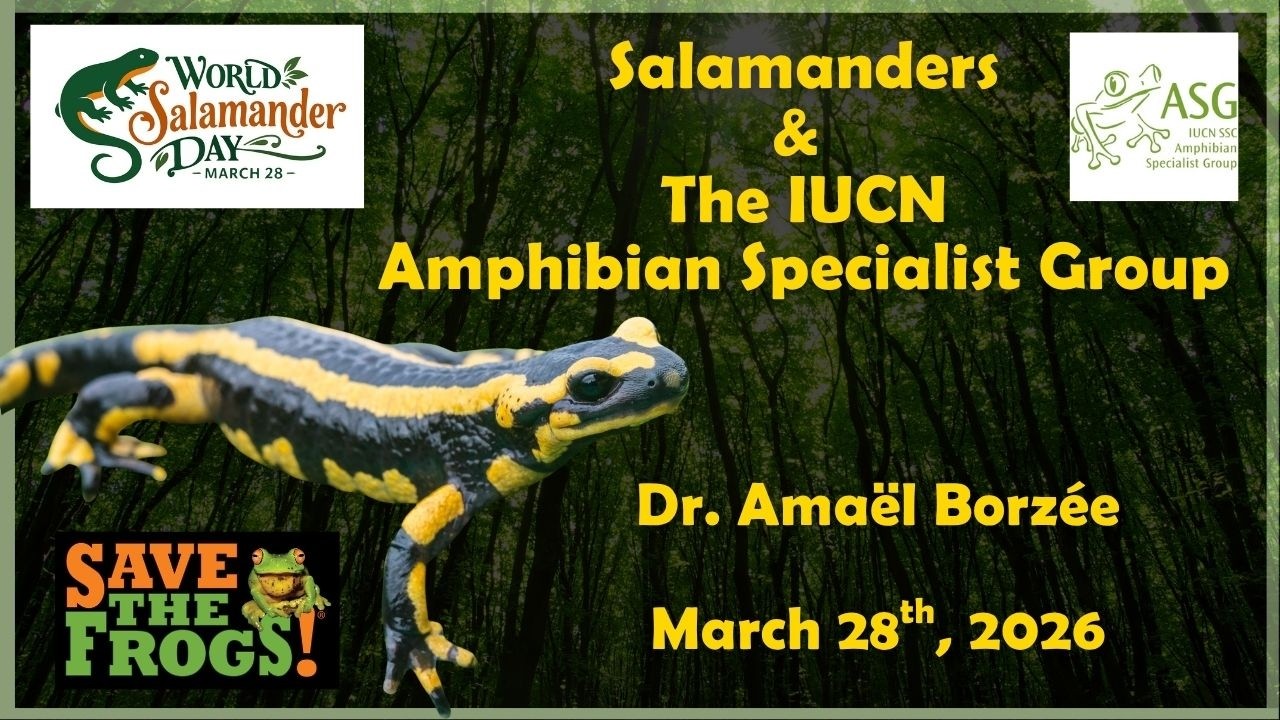
On March 28, 2026 — the inaugural World Salamander Day — SAVE THE FROGS! Founder Dr. Kerry Kriger was joined by Dr. Amael Borzée, Co-Chair of the IUCN SSC Amphibian Specialist Group (ASG) and Professor of Animal Behaviour and Conservation at Nanjing Forestry University, for a compelling overview of the ASG’s work in salamander conservation. Watch the video below!
The Crisis Facing Salamanders
Amphibians are the most threatened vertebrate group on Earth, with over 40% of species at risk. For salamanders, the situation is even more dire — more than 60% of species are threatened with extinction, and the rate of decline is accelerating faster than any other amphibian group.
About the IUCN SSC Amphibian Specialist Group
The ASG is a global network of 400+ volunteers working to provide the scientific foundation for effective amphibian conservation. Established in 2005, the ASG operates across 43 regional working groups and 12 thematic working groups, and oversees the Amphibian Red List Authority, which conducts cyclical assessments of all amphibian species. Their flagship publications — the Second Global Amphibian Assessment and the State of the World’s Amphibians (2023) — are freely available for download at iucn-amphibians.org.
The Amphibian Conservation Action Plan
Published in 2024, the Amphibian Conservation Action Plan (ACAP) is a comprehensive roadmap for global amphibian conservation. With 14 chapters and more than 100 authors, it covers key threats including habitat loss, climate change, infectious disease, and trade, alongside conservation tools such as conservation breeding, genomics, and translocation.
The Eastern Asian Salamander Task Force
Launched in May 2024, this task force has already made a significant impact. A horizon scan conducted with 80+ experts from 80 nations nearly doubled the recorded threats to Eastern Asian salamanders — from 481 to 839 — filling critical data gaps for IUCN Red List assessments and highlighting climate change as a previously underreported threat.
Reasons for Hope
Conservation actions are working. Between 2004 and 2022, species improvements more than doubled compared to the prior period — 86 improvements versus 35. Habitat creation and restoration are among the most impactful tools available.
📅 Mark your calendar: World Salamander Day is March 28 every year — join us for the 2nd Annual World Salamander Day on March 28, 2027!
💚 Follow us on Instagram: @worldsalamanderday
🦎 Subscribe to the World Salamander Day newsletter for news, updates, and alerts: worldsalamanderday.org/newsletters