Esta página aún no está disponible en español. Se muestra en English.
Presentation By Dolores Sanchez Gonzalez
On March 28, 2026 (the inaugural World Salamander Day), SAVE THE FROGS! Founder Dr. Kerry Kriger was joined by Dolores Sanchez Gonzalez, a microbiologist and incoming Ph.D. student at the University of Illinois Chicago, for a presentation on one of Illinois’ most fascinating and least observed salamanders: the mudpuppy (Necturus maculosus). This research was supported by a SAVE THE FROGS! Amphibian Conservation Award. Watch the video below!

A Salamander Like No Other
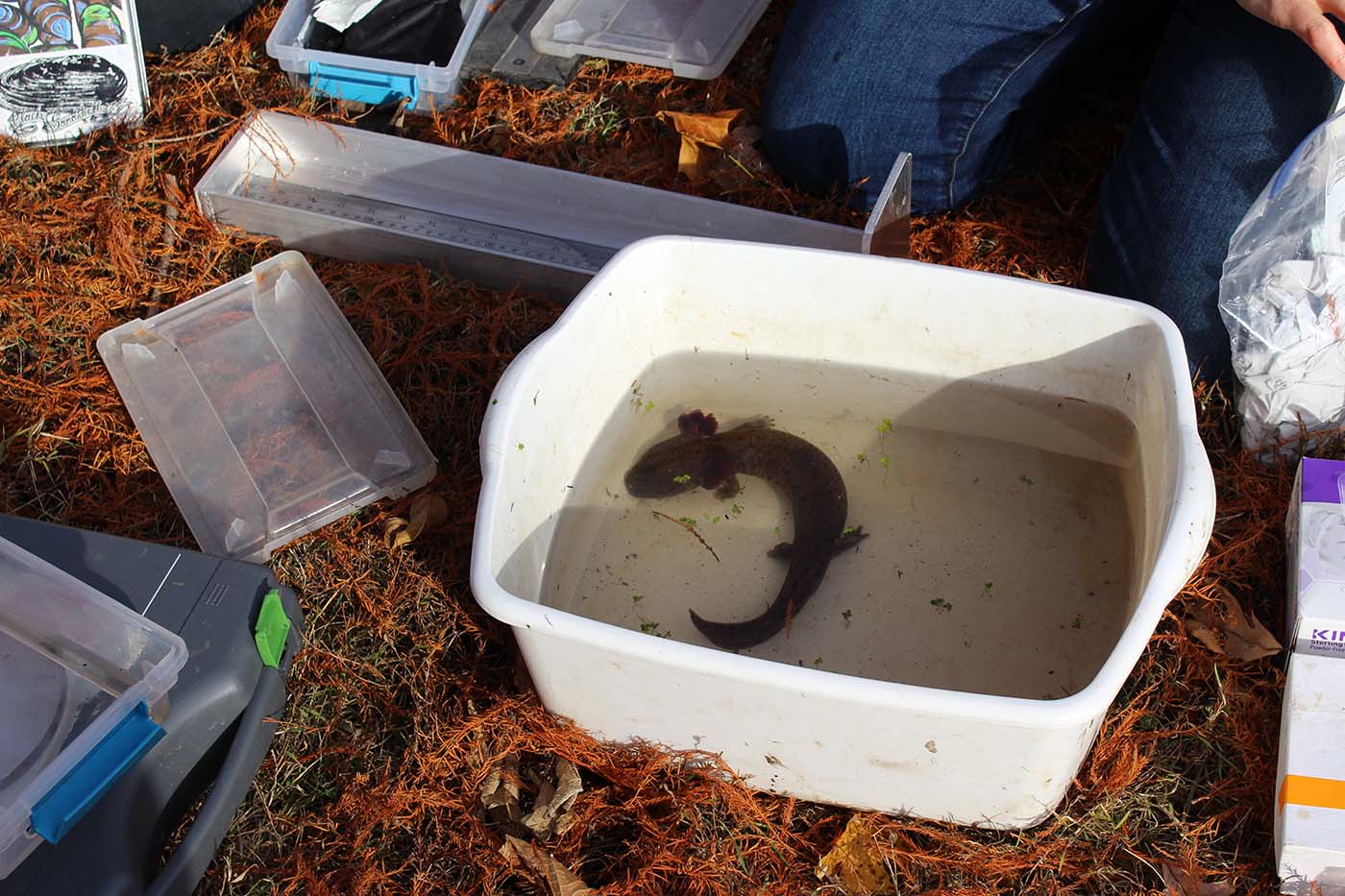
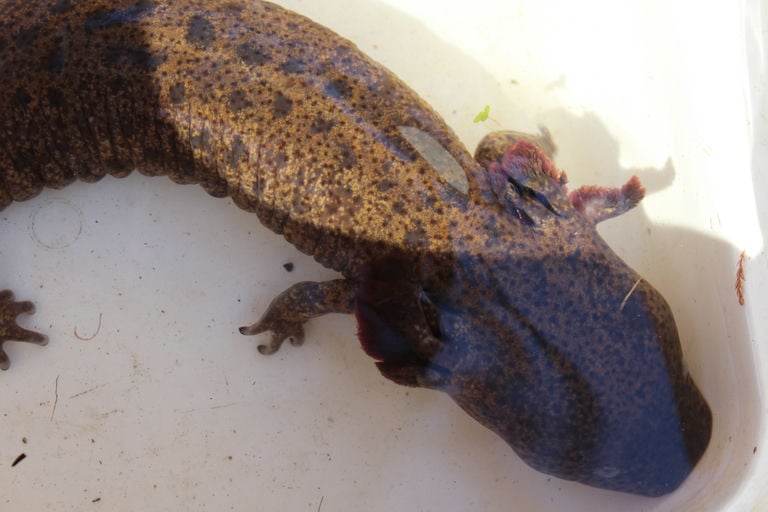
The mudpuppy is one of only a handful of fully aquatic salamanders in the world. Unlike most amphibians, it never leaves the water — retaining its large, feathery external gills from larva to adult for its entire lifespan of up to 20 years. Listed as threatened in Illinois and a species of concern across much of the Midwest, the mudpuppy remains poorly surveyed, with significant gaps in our understanding of its distribution, population trends, and response to habitat degradation. In Chicago it is listed as S1 — critically imperiled — and no live specimen had been recorded in Illinois for over a century before recent survey efforts changed that.
The Mudpuppy and the Freshwater Mussel
One of the mudpuppy’s most remarkable ecological roles is its relationship with freshwater mussels. The larvae of certain mussel species — called glochidia — parasitize the mudpuppy’s bushy external gills, completing a critical stage of their life cycle before dropping off as juveniles. When a survey team from the Illinois Natural History Museum and the Minnesota Department of Natural Resources used eDNA sampling across 25 historical sites to search for both the mudpuppy and its associated mussel, they made a landmark discovery: after more than a century without a confirmed live record, 12 live specimens of the mussel were found — including seven gravid females ready to reproduce.
eDNA and New Survey Methods
Environmental DNA (eDNA) is transforming how researchers detect cryptic, hard-to-find species like the mudpuppy. By filtering water samples collected with backpack eDNA samplers and analyzing them in the lab for genetic signatures, survey teams were able to pinpoint mudpuppy presence across three sites before deploying physical traps. Combined with traditional minnow trapping and direct mussel surveys, these methods are filling decades-long data gaps in mudpuppy distribution across the upper Midwest.
Engaging Chicago Anglers
One of the mudpuppy’s most overlooked threats is incidental bycatch. Anglers in the Chicagoland area regularly catch mudpuppies during winter fishing and sometimes leave them on the ice — driven by a widespread misconception that the animals are venomous or harmful to fish populations. Dolores responded by building relationships with Chicago fishing communities through Facebook groups, Reddit, and in-person conversations on the lakefront, and developed a web-based reporting app that allows anglers to log sightings, learn the mudpuppy’s threatened status in Illinois, and understand why returning a caught animal safely to the water matters.
About Dolores Sanchez Gonzalez
Dolores Sanchez Gonzalez will join the Ecology and Evolutionary Biology Ph.D. program at the University of Illinois Chicago in Fall 2026. Her research will examine how land use change and habitat degradation influence amphibian disease dynamics, using eDNA, microbiome analysis, and remote sensing to inform conservation efforts. Originally from Jalisco, Mexico, Dolores also visited the Cuetzalan Cloudforest Amphibian Sanctuary in Puebla, where she collected skin swab samples from salamanders as part of her interest in the antimicrobial and antifungal properties of amphibian skin microbiomes.
Reasons for Hope
After more than a century without a confirmed live record, the rediscovery of the mudpuppy’s associated freshwater mussel in Illinois — including reproducing females — is a powerful reminder that species can persist in places we stopped looking. The combination of eDNA technology, community science, and direct angler engagement is opening new doors for mudpuppy conservation in a region where so much remained unknown.
📅 Mark your calendar: World Salamander Day is March 28 every year — join us for the 2nd Annual World Salamander Day on March 28, 2027!
💚 Follow us on Instagram: @worldsalamanderday
🎓 Apply for a SAVE THE FROGS! Amphibian Conservation Grant: savethefrogs.com/grants
🦎 Subscribe to the World Salamander Day newsletter for news, updates, and alerts: worldsalamanderday.org/newsletters